![[personal profile]](https://www.dreamwidth.org/img/silk/identity/user.png)
Some of them are pretty long, so I'll put them each behind their own cut, and you can look at them as you please and at your leisure.
Here's the first four - an intro to the company, and pieces about Everything Must Go and Spell:
Gemini CollisionWorks is Ian W. Hill (arts) and Berit Johnson (crafts).
Gemini CollisionWorks has been around since 1997, at least as a name that IWH has been putting as a “production company” on all his theatre (and occasional other) artwork. The first play produced by GCW was Richard Foreman’s Egyptology (my head was a sledgehammer) as part of the No Strings Attached festival of plays by Foreman at NADA, which was also produced by IWH as GCW.
Berit became IWH’s partner in life and work in 2000, and GCW has been the two of them since 2001.
GCW became involved with The Brick vaguely in 2004 (IWH acted in a Summer Festival show), more strongly in 2005-2006, and became the tech direct ors of the space in 2007. Somewhat in return for their work in this position, GCW gets the month of August (at least for last year and this year) to do what they want, and what they want is to put up a lot of work. Last year, it was four plays on three programs, which was a bit much.
So, Gemini CollisionWorks is presenting “just” three shows in rep right now at The Brick. Of course, two of them this time were originals that were being created around the performers right up to the last minute, which were harder than almost any other shows GCW has produced.
This is somewhat foolhardy for a two-person company that does everything themselves, and drives us to the point of madness, but what the hell, we got it done and we’re pleased with the shows.
Well, Berit is pleased with the shows – Ian is too close to them to judge them in any real way and just has to keep asking Berit if any of them are any good or not . . .
IWH writes about the work as it happens at his blog, CollisionWorks, but has been asked for more info about the shows to promote them here on The Brick’s own blog.
So, in the next week or two, IWH will be looking at aspects of these three shows, how they were created, why they were created, and what they mean to us.
On Everything Must Go (Invisible Republic #2)
For the first of three entries, each on one of the three shows Gemini CollisionWorks currently has running at The Brick, I thought I’d go with the one at the top of my mind, as I have a performance of it in about seven hours.
It is, however, the hardest one to trace the lineage of . . . the other night, after our most recent performance, we had an audience that really enjoyed the show, but which then also came into the lobby afterwards wanting to talk with me about “What was that about?” and “Where did that come from?” And with this show, those questions aren’t so easy to answer. I did my best, and thinking about it then made it a little easier to deal with now.
It started (kind of) by deciding that I was going to create two original shows this year, at least. It might have been three, but I had first made this decision before the theme for the Summer festival at The Brick was announced, and when that turned out to be The Film Festival I knew it was the time to finally do my long-standing dream project, The Magnificent Ambersons by Orson Welles: A Reconstruction for the Stage rather than create an original work around the theme.
So, two original shows, both to go up in August. Spell was already bubbling at the top of my mind, not fully formed, but about as formed as I wanted it to be before going into rehearsal. As for the other one, the only thing I knew was that I wanted it to be built around a series of dances. I had a few dances planned out in my head for years to several songs, and started from the handful of those I thought could work in the context of a new play, which wound up being the dances I had dreamed to the songs “Slug” by Passengers (aka Brian Eno and U2), “Transylvanian Concubine” by Rasputina, and “Episode of Blonde” by Elvis Costello.
In the end, the latter two dances would wind up being very little like what I had pictured in my head for years (and the first almost identical) but that was the starting point.
My 2006 show That’s What We’re Here For (an american pageant) was a big, sprawling, ungainly piece that I’d like to bring back someday and fix and get completely right. It still had a lot of great things in it, especially the musical numbers, which were much liked. I got a lot of complements for them, my first baby-step into a land of dance and choreography that I’d been wanting to play in, but was too nervous about my own skills to really commit to. The praise I got for that show convinced me finally that, okay, time to do the full-out dance-theatre piece.
So I started with those dances that had been in my head for a while. Then I tried to imagine where all this could be taking place, and what came to mind was an office, and I could see the line up of desks where they could make the space interesting and also both facilitate some dance and at the same time interestingly restrict it. So what did this office produce?
Often, when creating a fake business like this, I just say they make “widgets” and leave it blank otherwise, but the more I thought about the space, it seemed to be a place where plans for selling things were schemed together. My love-hate relationship with the language of the advertising world began to come to the fore (as well as the more general officespeak that has become the province of the post-60s MBA-influenced corporate world). So it started to become “a play in dance and speech,” as I was thinking of it. I now saw mounds and mounds of jargon and more jargon and bad American speech broken up by explosions into musical numbers as releases from the tension of this horrible workplace.
Since I wanted to create this (and Spell) by going into rehearsal with a bare minimum of text and plans, and building the show around the actual voices and bodies of the performers who would be doing it, and go where that led me, I then had to start thinking about casting. I thought I’d have about 12-14 people in the show, and the only people I knew specifically that I had worked with before that I saw in this world and wanted to do the show were Gyda Arber and Dina Rose – both dancers, but of very different kinds – and Maggie Cino, with whom I’d done a well-received dance in TWWHF, and whose training is mostly in movement/acrobatics, which led to the rest of the casting in that I was now looking for dancers, or actors who could dance or at least move well, of a wide variety of types. I had two others on board for a while that I knew, but both of them had to drop out – and, not altogether smartly, I then took on the role of The Big Man – the boss of the agency – myself, which put more pressure on me during the process of this (and the other two shows) than I should have been handling.
A number of the people in the cast were new to me – actors I had been auditioning for a show I directed at Metropolitan Playhouse earlier this year - Merry Mount - or for Ambersons. Several people wound up coming from the company of Merry Mount, and another few from the auditions for Ambersons (in the case of David Arthur Bachrach, he wound up in both Ambersons and this).
After a lot of juggling around, losing some people, gaining others, we wound up with our cast of 11 – eight women and three men.
So, rehearsals. These at first consisted of me placing people around the room, looking at the pictures, and deciding what potential scenes these suggested. The cast and Berit would bounce ideas around as well, more movement would happen, and then I’d go home and write fragments of script, which I’d bring in and work at the next rehearsal. Then repeat this. Once there was the semblance of a structure, we started work on the dances.
The show went through a number of different titles before settling on the last, perfect one. For a while it was Dance To That Which One Is Created For, which is awful (and a quote from Glen or Glenda?), and for the longest time it was Invisible Republic, which I wasn’t happy with, until I realized it was a good and accurate subtitle. Everything Must Go just popped into my head one day, and was obviously right.
As I was writing, it was also apparent that, as with That’s What We’re Here For, the characters would all have stream-of-consciousness monologues about themselves, and between that, some of the Americana of the script, the quotes and use of verbal kitsch, and other connections, it became obvious that this show was #2 in a series beginning with TWWHF, which retroactively became subtitled (Invisible Republic #1). So now, between this and the NECROPOLIS plays, I have two continuing theatrical series I look to be going back to, both with their own specific rules and forms that must be kept to.
To my surprise, the dances came easy (at least easier than expected) and the writing was difficult (FAR more difficult than expected). I had some of the dances in my head, yes, but when confronted with working with REAL trained dancers on the pieces, I first tended to freeze up a bit. Even with all that, I was able to get across what I wanted, and was stunned as “Slug” and “Handsome Man” came to life in one evening in a tiny room at Champions Studios. Some of the numbers were very much choreographed fully by me, some were supervised by me – I would give a specific outline, and the dancers would fill in what I was looking for, giving me options that I could choose from, and some were very much taken over by the dancer/actors themselves when I just drew a blank on where to go (though I’d always make changes/corrections before they were set). Some had to be painfully hacked out bit by bit, but more often it was a fun process constantly full of the feeling of “Why don’t we try THIS?”
Songs and structure changed along the way. The first love song I’d picked for Becky Byers’ character turned out to be far too “passionate” to be workable in the show, and it took me forever to find a replacement song with the qualities I wanted. Gyda Arber, the musical-theatre expert of the company, also pointed out that as the number was (technically speaking) the “I Wish” number in the show, and as such, it was set too far into it, structurally. Moving it earlier in the piece suddenly solved a number of structural problems, and made the whole thing begin to take on the overall feel of a musical, albeit one with no songs, but dance numbers set to pop music of the last 75 years or so.
However, the “book” was proving problematic. I knew what had to happen in each scene, but the words just weren’t coming. I certainly have had writers’ block in the past, but not normally when writing this kind of material, where it usually just flows easily out of me. This one had to be hacked away at, slowly, or I had to sit around and wait for hours until some bright flash came to me and I began tearing through pages rapidly, trying to get as much done as long as I had the inspiration going. I wound up finishing the last pages of dialogue a mere four days before we opened. But it all worked. Thankfully.
I’m NEVER really happy with anything I do. I just can’t be, it’s me. All I see are the things I don’t like and can’t fix. However, EMG may still bring me more joy more consistently than anything else I’ve done – seeing these dances, that this is a play of MINE that has these beautiful pieces of music and movement coming together – both some serious tap hoofing and a lovely pointe solo, and everything in between – it just makes me pleased and amazed that it’s a show of mine. How the hell did THIS happen?
So, there it is, a play in dance and speeches about one day in the life of an advertising agency. But WHY and WHAT IS IT REALLY ABOUT?
Which are good questions, and not ones I can answer with any confidence. To me, the perfect show is one where those questions are raised, but they can’t be answered except by viewing the show itself, and then you can only get a non-verbal, internal answer that makes sense but can’t be put into words without being reductive.
If I had to try and say myself, I’d say it’s a cautionary tale about selling out, and the way it can happen by small degrees, without being aware that it’s even happening, until humanity (represented in the dances) is lost in a mound of jargon and rules and structures that have nothing to do with human beings, and everything to do with planned ideas of “how to run things efficiently.”
There are people who know my work well, though, who always seem to think that every one of my pieces is itself about Art and more specifically about Theatre and the creation of it, and when that idea was floated to me the other night about this piece, I couldn’t find any holes in that way of looking at it – it does seem to be a metaphor for creating theatre, at least at the level I’ve been doing it for years now – with The Big Man (played, after all, by me) as Director, pulling his subordinates (actors) together against all odds to create this project that Has To Happen Now, with a combination of motivational speaking and careful guidance, until the final project happens, and all are proud of it . . . and then it’s ephemeral and goes away, and there’s just the next tiring project to move on to tomorrow. I’ve even placed in the mouth of my character phrases that I use all the time in directing actors.
So in the end, maybe it’s a more revealing piece than I imagined, about whether all this work that goes into these theatre projects is, in the end, worth it – the kind of thinking that is just a bit on my mind these days. Certainly wasn’t intended that way, though.
I just wanted to make a pretty play with dance numbers that was fun and at the same time had some bittersweet things to say about where America had come, especially in terms of selling things to people that they probably don’t really need and maybe aren’t so good for them.
After the show the other night, the friend of a cast member asked me, “So, are you an experimental director who’s playing with mainstream forms here, or are you a more mainstream director who’s getting a little more experimental with this piece?” At first I thought I knew how to answer that question, but after a moment’s reflection it seemed a lot less clear to me.
The final moments of Everything Must Go wound up taking their inspiration from a quote of Richard Foreman’s that was related to me by director Edward Einhorn, who interned for Richard on The Universe - at the end of that Foreman play, James Urbaniak’s character had to make a decision about drinking a glass of milk or not. It is somewhat obvious by this point in the play that the glass of milk represents BAD THINGS – everything that keeps human beings trapped in their little boxes, desiring the pleasures of the body rather than larger spiritual goals. In rehearsal, Richard still wasn’t decided on the ending, and one day said to Edward, “Now if he doesn’t drink the milk, it’s a comedy – if he DOES drink the milk, it’s a tragedy.”
In Foreman’s play, Urbaniak drinks the milk. A tragedy.
As we created the ending of Everything Must Go, Berit and I flashed on the same thing with our own situation . . . “If she leaves the pen, it’s a comedy – if she TAKES the pen, it’s a tragedy.” And had to decide ourselves which way it went.
So where did our play wind up? You’ll have to see it to find out . . .
On Connections and Inspirations: Spell and Everything Must Go
Something I didn’t mention in the Everything Must Go write-up, which I’ve been reminded of and encouraged to mention (especially so as to break up these massive blocks of text of ME talking about MY WORK, yeesh) was the influence of outside, older artworks in the creation of these pieces.
It’s rarely other theatre or playscripts that stick in my head and bounce around, causing some kind of inspiration in what I’m working on myself, but usually visual art and popular musics that do the trick. Sometimes film (as was the case here).
For example, in the midst of all the inspiration for EMG, in language, and dance, and images in my head of light on bodies moving, one picture and song kept coming back to me (and both wound up being used directly in the show itself), Richard Hamilton’s 1956 collage Just what is it that makes today’s homes so different, so appealing?:
And a song by Roxy Music that may have been somewhat inspired by Hamilton’s collage (Hamilton was a teacher of Brian Ferry at the University of Newcastle), “In Every Dream Home a Heartache”:
Somehow these captured the feel of the consumer culture/advertising world I was dealing with in the show.
For Spell, a more mysterious combination of image and song asserted itself. First, in a way that I cannot explain in any logical, conscious manner, another great 20th-Century collage filled my head in an unexplainable. inspirational way, John Heartfield's Hurrah, die Butter ist alle!: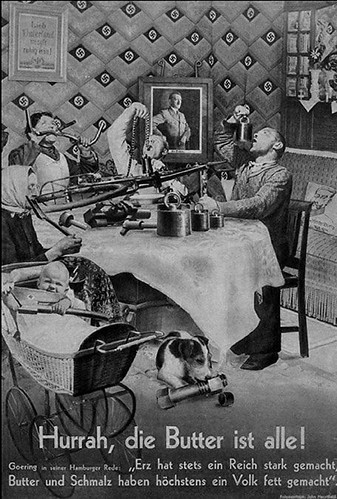
"Hurrah, the Butter Is Finished!"
Goering: "Iron has always made a nation strong, butter and lard have only made the people fat."
Bob Dylan hung over Spell in some strange spiritual way (his song, "High Water (for Charlie Patton)" from Love and Theft has been close to me since 9/11/01, and part of a direct line of thought that led to the play). For some reason, a song of his that isn't at all one of my favorites - it's nice, but not one I ever would have put at the top of my list of Dylan classics - became important to the show, "It's All Over Now, Baby Blue" - in particular, the version performed by The 13th Floor Elevators:
I had started Spell with some fragmentary texts that suggested a woman being interrogated by a figure that could be a doctor or a law-enforcement official. She appeared to have mental problems. Gradually, it became apparent she had done something monstrous and murderous. Then these Witches appeared - voices in her head, and they used numbers to communicate (a detail mostly dropped from the final show, but there are bits and pieces of it scattered around in there). And songs that used numbers in strange, incantatory ways suddenly became important to me - I had planned to quote from them in the show, but they mostly wound up being regulated to the pre-show mix, but something in all of them felt "right" for the show, and somehow inspired the tone of the show, like the traditional "Children Go Where I Send Thee" here performed by Johnny Cash:
"Papa Legba" by Talking Heads, performed by Pops Staples:
"Monkey Gone To Heaven" by Pixies:
"Highway 61 Revisited" by Dylan, performed by PJ Harvey:
and Love's "The Red Telephone":
This last song became not only important for its use of numbers, but also for the outchorus talking about madness, some of which is quoted from Marat/Sade (more on that in the next entry), which led neatly into the opening image of the show itself.
(another important inspirational song which didn't have the number conceit, but was connected to the show in other ways, was Patti Smith's version of "Hey Joe" where she turns it into the story of Patty Hearst - I'd include a video of that, but I found a neater video of the song done live in 1976 in a medley with "Horses," but without the Hearst conceit, so I'll just link to it - it's HERE)
Spell and Everything Must Go were created slowly over months, as I worked bits and pieces of them, and figured out what the shows were about as I went. I would hear music like some of the above, or other tracks, and know they belonged in one of the shows, but not be sure which one. The shows are extremely different, but have some strange overlaps that connect them. Berit said that EMG, which is subtitled (Invisible Republic #2) is about the Invisible Republic I keep returning to in my work (the America beneath the bright shiny surface where all the horrible scurrying things go on), and that Spell takes place inside the Invisible Republic, which seems right to me.
With the dark, nasty Spell and the deceptively cheerful and funny EMG going on together, I was reminded early on of the two films that Ken Russell made in 1971, the dark and nasty The Devils and the deceptively (?) cheerful and funny The Boy Friend, and I rewatched both films, and came away with a great deal more inspiration for both than I had anticipated.
They were both closer than I had figured to what I was trying to do in some way with my own shows, and, as I'd always had the feeling was true with Russell, I needed each show, the dark and the light, for proper balance. Here are both movies in their entirety - really. I was just looking for trailers or clips or something, but instead found that these two films (as yet unavailable on DVD) have been uploaded to YouTube. So here's Ken Russell's two 1971 features that directly influenced my two 2008 plays:
And here's The Boy Friend:
(and if you actually want to watch these for any length of time, I suggest clicking on the links in the titles above each video here to open the playlist directly in YouTube, where you can click on each chapter of the playlist to "watch in high quality" - an annoying new YouTube function which means embedded videos never look as good as when you see them on YouTube itself - and you HAVE to choose the "high quality" setting for each chapter as it comes up - NOTE: not all chapters of each film have a "high-quality" mode)
Once I had seen that there was some kind of connection between the two shows in my head, little bits of each show began oozing into the other -- the company where EMG takes place is mentioned in Spell, and the title of that show and the inclusion of The 13th Floor Elevators somehow fall through into EMG. Now they are a kind of matched pair, resembling each other barely, but echoing each other totally. At least for me.
Next entry: The original texts that started Spell, and more on the inspirations for that specific show.
On Spell: Creation and Influences
Spell started from some fragments in some notebooks and computer files. Someone was talking, and somehow I realized it was a woman named "Ann."
Ann said a few things here and there that I took down.
Someone was talking to Ann - I called him "Bill," just to give him a name at first, but I never figured that name would stick (and it didn't).
In one of the fragments, to my surprise, some witches appeared, and the word "spell" came to mind as a possible title for where this was going.
I finally put together one file of all the little fragments I had in different places that seemed to want to go together. It was a 4-page Word file called "SPELL" and this was what it said:
*****
(fragments to be figured out and ordered later)
(light bulb scene)
ANN
Say we had a light bulb here . . .
Light bulb on stand shoots up out of the center of the table. ANN points her finger at it like a gun, “pulls the trigger,” and it clicks on.
ANN
. . . and it’s on. I can’t just look at that and deal with it as just a light bulb
(detailed light bulb explanation to come)
Not just light bulbs. Something that complex. Tables. This table. Who built it, where, what hands, what conditions. How did he or she feel? Did they have a cold? Who did they give that cold to, later that day after they made their piece of this thing?
I’m in a diner, I go to put the sugar in my coffee from one of those sugar pourers, you know, the, the diner . . ?
(Demonstrating the “diner kind” of sugar dispenser with a pouring gesture. BILL nods.)
And who made that, that there in my hand? Not just that, that there’s a factory somewhere of people, lots of people, making these. And a place in that factory, maybe a factory of its own somewhere where they just make those little metal flaps at the top of the lid that the sugar comes through. Just that little piece of metal, and how many people did it take to make that, and who are they, and what are their lives around making these little pieces of metal. I picture them. I follow them home. I watch their TV shows . . . dinner . . . evening with the kids . . . maybe friends over . . .
It’s paralyzing. Not being able to just ignore it. Accept it. If that’s . . . You get what I mean?
BILL
Does that make things difficult?
ANN
(bitter irony)
Well, it makes it difficult to acquire money. If you know what I mean. Earn my keep.
BILL
What do you want to keep?
*****
ANN
(looking off)
I hear voices . . .
BILL
Tell me about these voices.
ANN
No, I mean—
BILL
Don’t be afraid.
ANN
I’m not afraid, I just—
BILL
Stay a spell.
ANN
Stay what spell?
Spell occurs. Three witches. Silhouetted through back scrim wall.
WITCH 1
Stay.
WITCH 2
Sit.
WITCH 3
Remain.
*****
(floor becomes ceiling – fabric – on pulleys)
(noir detective)
(ANN gender switch, back and forth, unsure – ANDY, maybe?)
Sit a spell.
Spell this.
Spell it for me?
Are you good at spelling?
*****
ANN
I thought I was an artist. I was always told I was an artist, so, hey, I’m an artist, right? Then I got to thinking I was just a craftsman. Woman. Craftswoman? Person? Crafter. Crafty? Then I decided I was somewhere in between, and what kind of place is that to be? After all.
*****
(politeness/manners/chivalry part of monologue)
(being in the grey, between black and white, problems, advantages, disadvantages)
(things have moved on)
(technology. shifts.)
(bread and circuses)
(business scene with lots of machine sounds, images of money, bills, large. projected?)
(noir figures. violence. multiple beatings.)
*****
Well, anything can happen in this place.
Do you mind?
Mind?
Mind.
Me mind?
You mind.
I mind everything and nothing. All at the same time.
*****
(everything slides)
(drug, voices, insanity, dealing with it discussion)
*****
Did you ever want to be normal?
Jesus, hell, no!
(beat)
Well, no, maybe that’s not true. For a moment, time to time, very brief. Only when I was in discomfort and wanted comfort. Thought “normal” would have given it to me. Ease. An easement, of a kind.
*****
Say this was—
(as a repeated opening to various scenes/thoughts)
(ANN and ANDY alternate imagining the lives of people in businesses/houses seen from a train – “Colonel F.G. Ward Pumping Station,” “Mr. Fox Tire Company,” “Sal’s Collision and Son,” “Action Box and Container;” a factory with cracked windows painted with green enamel; plains of burned-out, busted, and just plain left for dead vehicles; a back sunporch on a river, filled with stuff, over the windows and the screen door; two International Klein Blue doors stuck in the side of an old, shabby tin warehouse; a faded smiley face with “Always Happy To Serve You!” in italic on the yellowed sign of a building, no other signage visible.)
*****
And that was a start. To continue, I decided that Ann should preferably be played by Moira Stone, so I had a voice in my head to write for specifically.
Other things began appearing in the fragments. Bombs and terrorist references started showing up. Then I realized that Ann was being questioned in a little grey room somewhere. Was it a doctor or a military interrogator questioning her?
Maybe both?
Or maybe not, but she sees it as both.
Ann, as noted at the end of the notes above, now also had a male alter-ego, Andy. But wait, which one was the real one? Was one dreaming the other?
And maybe the interrogator was also one person split into two genders?
Possibilities continued to assert themselves.
As with most of my work for the last few years, this was becoming a piece about the United States of America, and was in some way a scream of pain about where things had gone and were going - badly - for this country that I love and feel so conflicted about. It was becoming an argument between my heart, which had begun to believe that violent revolution was the only way any positive change was going to happen here, and my head which is well aware that violent revolutions almost never work out in the long run. The argument in my own soul became the argument in this little chamber that is also the inside of Ann's head, with all the various voices and points of view trying to make themselves heard.
I rewatched some of my favorite movies - one of my favorite conceits, dramatically, is that the work is happening inside the head of the main character, and we are perceiving things as he/she interprets them emotionally/psychologically, not as they are "really" happening. So I watched Point Blank and Fight Club and Bad Timing and Detour and Myra Breckinridge and especially the David Lynch series of stories told inside the minds of people trying to run from the horrors of what they've done (or is being done to them) in the "real" world: Twin Peaks; Fire Walk With Me, Lost Highway, Mulholland Dr., and INLAND EMPIRE (and one could arguably include Blue Velvet and Eraserhead in this form as well, maybe).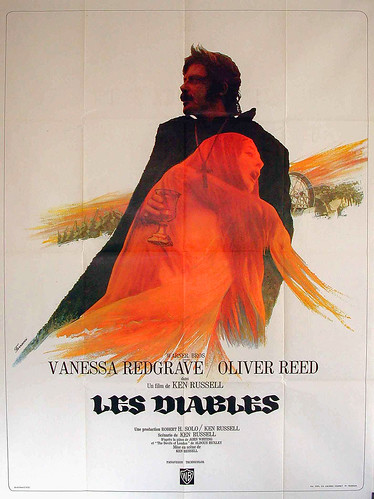
As mentioned last entry, I also watched Ken Russell's The Devils, which involves a person being interrogated for a crime that they do not consider a crime by a governmental organization, and which, as typical with Russell, goes wonderfully off the rails into stylization, almost abstraction. 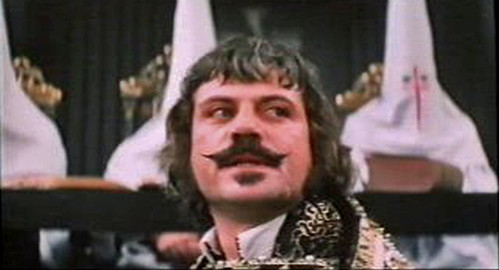
The Devils, which began life as a stage play by John Whiting as well as a novel by Aldous Huxley, reminded me of another stage work transformed into film that interprets and twists some real historical facts (both, oddly enough, in France) into a new statement: The Persecution and Assassination of Jean-Paul Marat as Performed by the Inmates of the Asylum of Charenton Under the Direction of the Marquis de Sade (aka Marat/Sade) by Peter Weiss, directed by Peter Brook. Watching this film, I felt even more of a kinship with certain aspects of what I was going for, in terms of political debate in a cell, with madness lurking.
Here is the entire film of Marat/Sade (if you really want to watch it all online, best to click on the title link I just gave and then click on "watch in high quality" as each of the ten chapters comes up):
As this was happening, I was assembling a cast that seemed right for this play (and, luckily, Moira could do it). I wound up with a fine one to start - and still, as not all of them made it to the performances themselves, due to getting jobs they couldn't refuse - a good one to finish.
I started work with the cast with just fragments like the ones above, and some music, figuring out the scenes and structure as I went. The cast members, who I was now writing the play for and around, influenced it greatly in their own persons, attitudes, backgrounds and voices. I wrote lines of dialogue and used tones of voice I wouldn't otherwise, just because I could HEAR the voices of the actual cast talking in ways I wouldn't always have going inside my head.
For example, I had wanted, just for sonic purposes, the witches to speak non-English languages. I was tired, even as someone who speaks only English fluently and French brokenly, in the tyranny of the English language all around me and in my shows, so I cast actresses who could speak other languages. Somewhat by chance, these actresses I cast were Cuban, Palestinian, and Chinese-American. Now, in a play about patriotism, nationalism, violent revolution and/or freedom fighting (depending on how you look at it), this suddenly became Something That Had To Be Dealt With - and quotes from Castro, Che, Arafat, and Mao suddenly wound up being juggled into the mix. Which was hard, and it took me a while to figure out how to do this without upending the play into endless didactic political discussions - in fact, it took almost up to the last minute, but I'm happy with where it went.
It was weird how and where ideas would come . . . I was still trying to figure out how to write the scenes between The Man - a representation of various men from Ann's past - and the three Fragments (aspects of Ann in her past personae), without much luck when I frustratedly went out to get Berit and I some dinner one night, and as I was turning my car from Avenue S right onto Ocean Parkway, the entire way to write the first Man/Fragment scene appeared in my head just during the time I had the steering wheel turned. One of the best "Eureka!" moments I've ever had as a writer, though at the same time worrying, for it seemed like the solution was to write a scene that - to people who knew Berit and I - might sound as if it were, uncomfortably, a transcribed argument between the two of us shoved into the play. It isn't, and we don't have discussions quite like this one, but you might think it's about us if you just know us a bit.
I'm not sure how strong you could say Berit's influence on this play is. One friend, after seeing it, said, "So, you wrote a play about someone who's a combination of you and Berit going insane." I was a little put off by that, even though Berit somewhat agreed with the assessment. I think it may be a bit reductive of what the show is. Still, while I did write all of it (except for the quotes), I don't think certain aspects of it could have come out of me without B's influence in my life, especially the gender/feminist sections.
At the same time, B is worried about putting the valid feminist arguments in the mouth of a violent madwoman, but then she shrugs her shoulders and says that there's no way to be 100% PC on this stuff, so why try . . .
Moira Stone as Ann, Fred Backus as General Doctor Jane, and Alyssa Simon as Doctor General Jane (or is it the other way around?)
I was writing and fixing up until days before opening, but wound up with a script I'm pretty damned proud of. There are bits I'll probably go back, look at and rethink after the run, but it's my first original 2-act play, and it works pretty much as I want it to.
More notes tomorrow on influences for Everything Must Go, and maybe I'll get to Harry in Love as well . . .


